 5mg vial
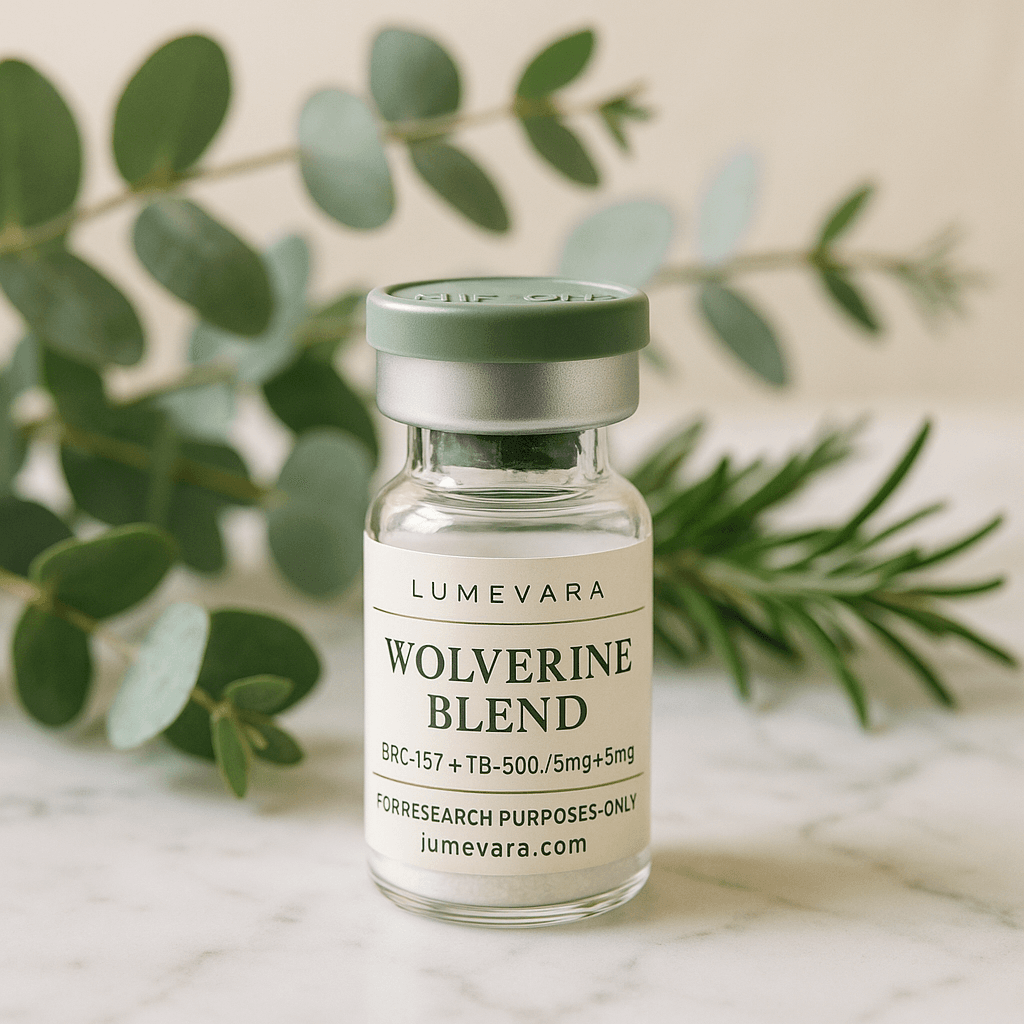
TB-500
The Tissue Peptide
$49.99
5mg vial
For research purposes only
Chemical Properties
About This Compound
Molecular Profile
TB-500 is a synthetic 17-amino-acid peptide (Ac-LKKTETQ; more precisely the actin-sequestering region Ac-SDKPDMAEIEKFD KSKLKK, residues 17–23 of Thymosin Beta-4; MW ~889 Da, CAS 885340-08-9) corresponding to the central G-actin-binding domain of the endogenous 43-residue protein Thymosin β4 (Tβ4). The primary molecular target is monomeric G-actin, to which Tβ4 binds with a Kd of approximately 0.5 µM (De La Cruz et al., Biochemistry 2000). This interaction sequesters actin monomers, shifting the G-actin/F-actin equilibrium and inhibiting actin polymerization nucleated by Arp2/3-independent pathways. Downstream signaling includes ILK (integrin-linked kinase) activation and modulation of the PINCH-ILK-parvin ternary complex, which regulates focal adhesion formation and cell spreading. Tβ4 and TB-500 also upregulate VEGF and MMP-2 transcripts in endothelial cell models. LOXL2 (lysyl oxidase-like 2) expression changes have been reported in wound models. No classical GPCR or kinase receptor has been identified; the mechanism is cytoskeletal rather than receptor-transduction-based.
Published Data
No human clinical trials for TB-500 exist in the published literature. All data is from cell culture or rodent/lagomorph studies. Goldstein et al. (Ann N Y Acad Sci, 2005) characterized the actin-sequestering mechanism and wound-closure activity in cell migration assays. Sopko et al. (J Cardiovasc Pharmacol, 2011) reported reduced infarct area and improved cardiac function metrics in a rat myocardial infarction model following Tβ4 treatment. Philp et al. (J Pharmacol Exp Ther, 2004) described dermal repair outcomes in full-thickness wound models, with histological differences in collagen deposition versus controls. Hair follicle stem cell mobilization was investigated by Ito et al. (Nat Cell Biol, 2004) for the full Tβ4 molecule; whether the TB-500 fragment recapitulates this fully is not established. MMP modulation data derives primarily from in vitro endothelial cell experiments and has not been replicated across multiple independent labs using the TB-500 fragment specifically.
Research Relevance
TB-500 is used as a pharmacological tool for studying G-actin dynamics, cell migration assays, and ILK-associated focal adhesion signaling. It is relevant to researchers investigating cytoskeletal regulation in wound closure, angiogenic sprouting, or cardiac remodeling contexts. The distinction between full-length Tβ4 and the TB-500 fragment is methodologically important; some published findings use full Tβ4 and may not transfer directly. No in-human data exists. Classified for research use only.
Related Research Compounds
All products are sold strictly for laboratory and research use only. Not for human consumption. No statements on this page have been evaluated by the FDA. These products are not intended to diagnose, treat, cure, or prevent any disease.