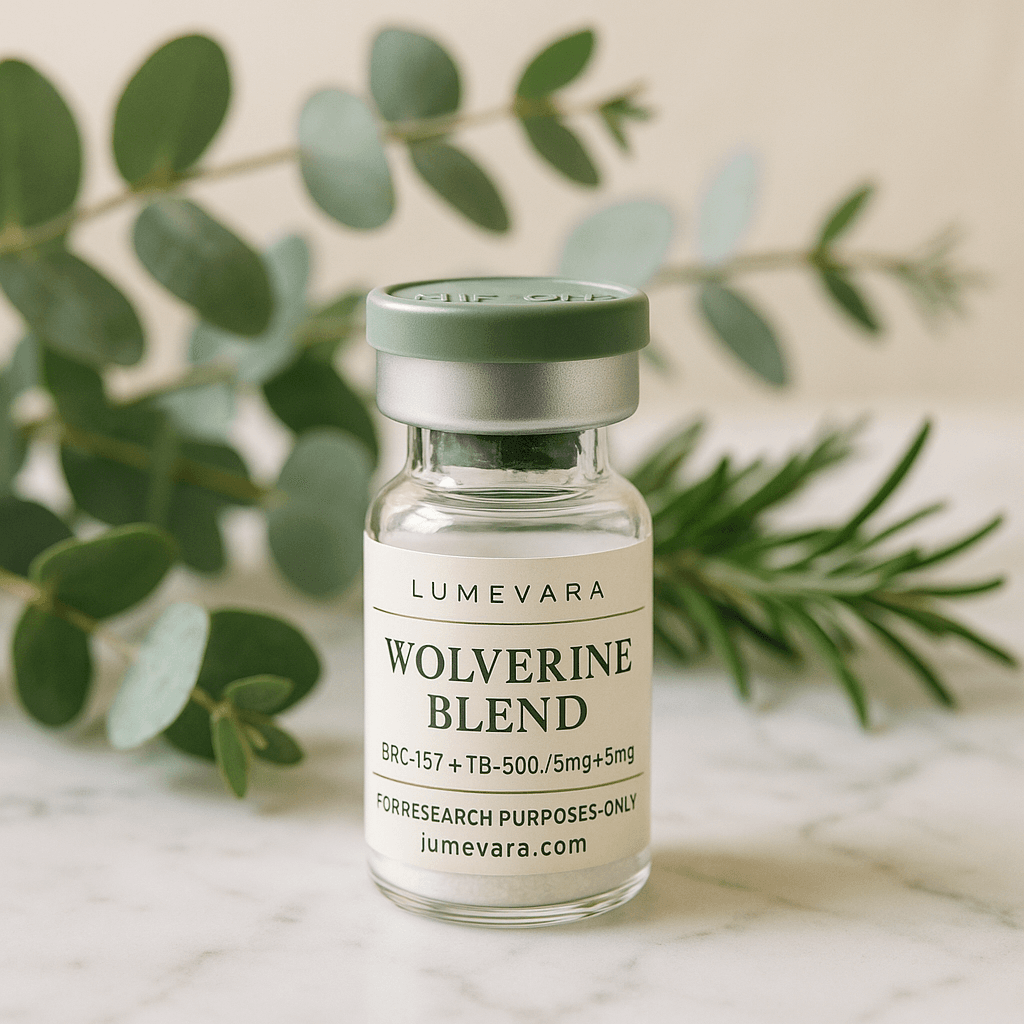
 5mg+5mg vial
BPC-157 + TB-500 (Wolverine Blend)
Dual-Peptide Research Blend
$90.00
5mg+5mg vial
Dual-peptide blend combining BPC-157 and Thymosin Beta-4 fragments researched for tissue signaling and cellular migration pathways. For research purposes only.
For research purposes only
Chemical Properties
About This Compound
This compound combines BPC-157, a 15-amino-acid fragment of the gastric secretory protein BPC (sequence GEPPPGKPADDAGLV), with TB-500, a 43-amino-acid synthetic analog of the N-terminal actin-binding domain (residues 17-23, LKKTETQ) of Thymosin Beta-4 (Tβ4). The two peptides operate through distinct and non-overlapping molecular mechanisms.
Molecular Profile — BPC-157
BPC-157 modulates the nitric oxide (NO) system through interactions with both the NOS-NO-cGMP pathway and the NO-independent soluble guanylyl cyclase pathway. Published in vivo data documents upregulation of VEGFR2 (KDR/Flk-1) and EGR-1 transcription factor expression in rat tissue models (Seiwerth et al., 1997; Sikiric et al., Curr Pharm Des 2018). The peptide also interacts with the FAK-paxillin signaling axis, which regulates focal adhesion dynamics in cell migration assays.
Molecular Profile — TB-500
TB-500 functions primarily through G-actin sequestration. The LKKTETQ motif binds monomeric G-actin, modulating the G-actin/F-actin equilibrium and thereby influencing cytoskeletal reorganization during cell migration. Published data demonstrates TB-500-mediated activation of integrin-linked kinase (ILK) and downstream Akt/PKB phosphorylation in cardiac progenitor cells (Bock-Marquette et al., Nature 2004). TB-500 also upregulates expression of VEGF-A and HIF-1α under hypoxic culture conditions.
Published Data
BPC-157 and Tβ4 have been characterized independently across >100 published preclinical studies. BPC-157 pharmacology has been reviewed extensively by Sikiric et al. (Curr Pharm Des 2018). Tβ4/TB-500 receptor pharmacology and ILK signaling data were characterized by Bock-Marquette et al. (Nature 2004). No peer-reviewed studies have yet characterized the pharmacokinetic or pharmacodynamic interactions of the combined formulation.
Research Relevance
The blend provides a dual-mechanism compound for experimental designs examining NO/VEGF pathway signaling in conjunction with actin-dependent cytoskeletal reorganization — two mechanistically independent axes relevant to tissue biology research.
Peer-Reviewed Studies
Seiwerth, S., Sikiric, P., Grabarevic, Z., et al. (1997)
Journal of Physiology-Paris, 91(3-5), 173-178
Bock-Marquette, I., Saxena, A., White, M.D., et al. (2004)
Nature, 432, 466-472
All products are sold strictly for laboratory and research use only. Not for human consumption. No statements on this page have been evaluated by the FDA. These products are not intended to diagnose, treat, cure, or prevent any disease.