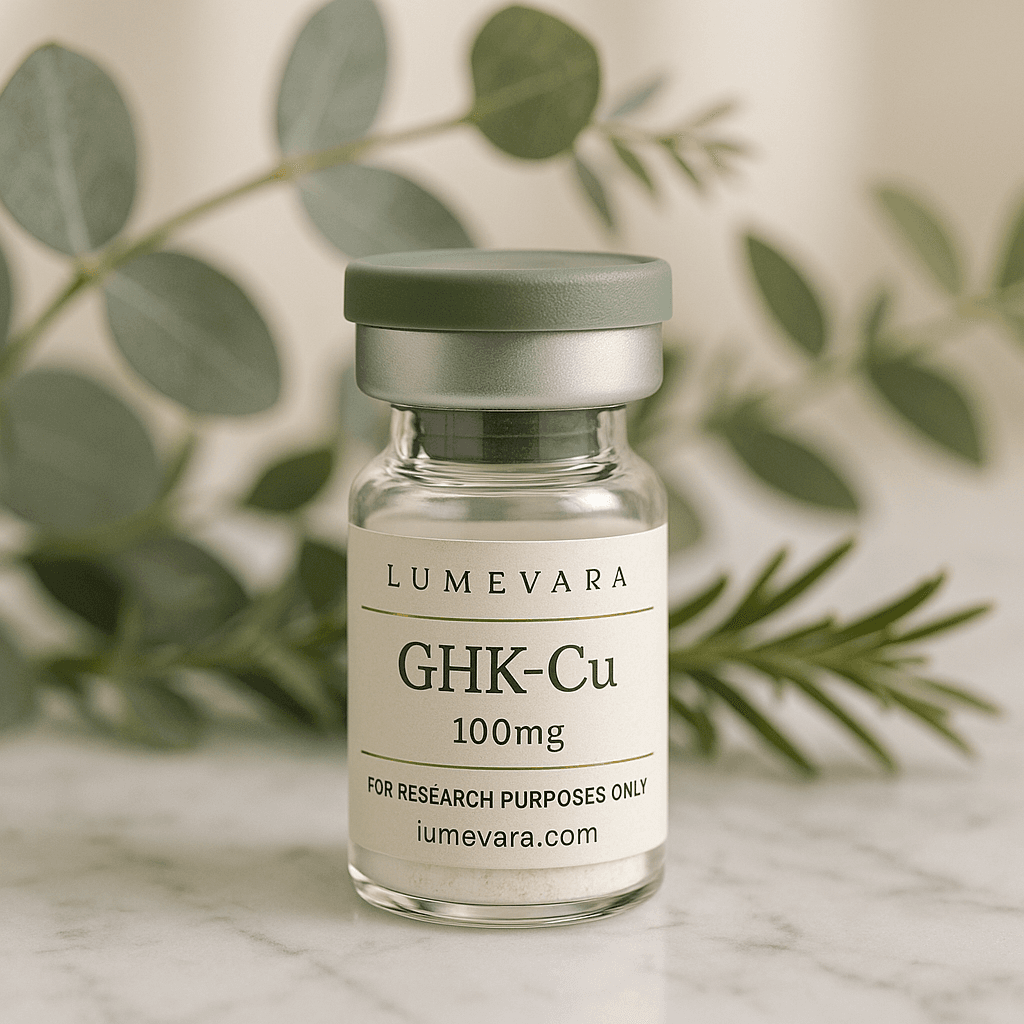
 100mg vial
GHK-Cu 100mg
Copper Peptide Complex
$65.00
100mg vial
Copper-binding tripeptide researched for skin remodeling, collagen signaling, and antioxidant pathways. For research purposes only.
For research purposes only
Chemical Properties
About This Compound
GHK-Cu (Glycyl-L-Histidyl-L-Lysine:Copper(II), 1:1 complex) is an endogenous tripeptide-metal chelate first isolated from human plasma by Pickart & Thaler (1973). The Cu²⁺ ion is coordinated through the glycyl amino nitrogen, histidyl imidazole nitrogen, and deprotonated amide nitrogen in a square-planar geometry (Freedman et al., BBA 1982).
Molecular Profile
The copper coordination chemistry is central to GHK-Cu's documented biological activity. The Cu²⁺ ion participates in superoxide dismutase-like redox cycling and serves as a cofactor delivery mechanism for copper-dependent enzymes including lysyl oxidase (LOX), which catalyzes oxidative deamination of lysine residues in collagen and elastin precursors. Circulating plasma concentrations have been measured at approximately 200 ng/mL in young adults, declining to ~80 ng/mL by age 60 (Pickart, 2008). Connectivity Map (CMap) analysis of GHK-Cu gene expression signatures identified modulation of 4,048 human genes at p<0.05, with significant enrichment in ubiquitin-proteasome pathway, TGF-β superfamily signaling, and Nrf2-mediated oxidative stress response genes (Pickart et al., 2012).
Published Data
In vitro studies using human dermal fibroblast cultures documented upregulation of COL1A1, COL3A1, and decorin (DCN) mRNA expression following GHK-Cu exposure (Maquart et al., FEBS Lett 1988). Separate investigations characterized its effects on matrix metalloproteinase (MMP-2, MMP-9) activity and integrin α₂β₁ expression in cell migration assays. Gene expression profiling (Pickart et al., BioMed Res Int 2015) catalogued pathway-level effects across DNA repair (GADD45A), antioxidant response (HMOX1, NQO1), and WNT signaling components.
Research Relevance
GHK-Cu is a well-characterized copper-delivery tripeptide with an extensive published dataset across gene expression, metalloenzyme cofactor, and extracellular matrix remodeling research domains. Its endogenous origin and known age-dependent plasma concentration curve provide a defined physiological reference frame for in vitro experimental design.
Peer-Reviewed Studies
Pickart, L., Vasquez-Soltero, J.M., & Margolina, A. (2012)
Oxidative Medicine and Cellular Longevity, 2012, 324832
Pickart, L., Vasquez-Soltero, J.M., & Margolina, A. (2015)
BioMed Research International, 2015, 648108
All products are sold strictly for laboratory and research use only. Not for human consumption. No statements on this page have been evaluated by the FDA. These products are not intended to diagnose, treat, cure, or prevent any disease.