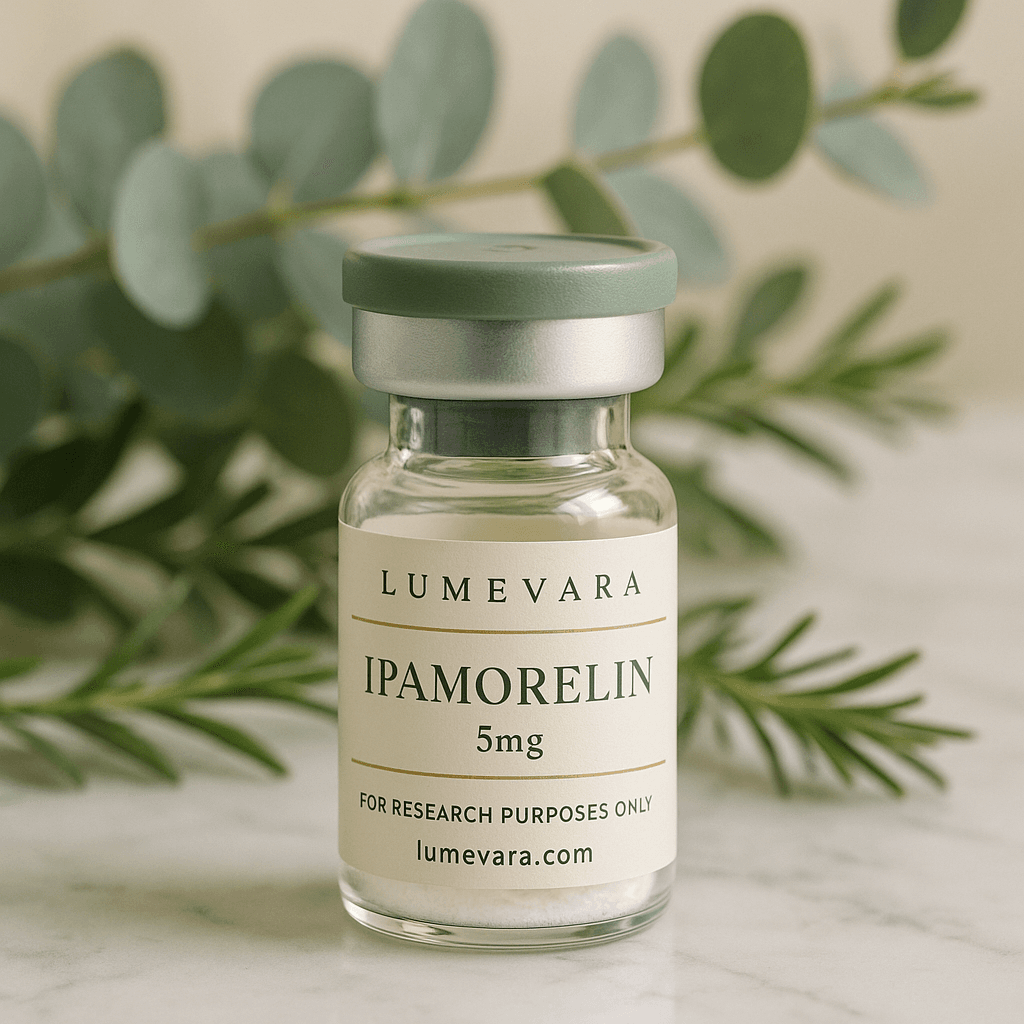
 5mg vial
Ipamorelin
The Clean Releaser
$39.99
5mg vial
For research purposes only
Chemical Properties
About This Compound
Ipamorelin earned a distinction that no growth hormone secretagogue before it could claim: it was the first to stimulate robust GH release while leaving cortisol and prolactin virtually untouched. That selectivity wasn't just a scientific curiosity — it was a breakthrough that redefined what researchers could study about the ghrelin receptor system without the confounding effects of off-target hormone stimulation. Today, Ipamorelin remains the gold standard for selective GH secretagogue research.
What is Ipamorelin?
Ipamorelin is a synthetic pentapeptide and highly selective growth hormone secretagogue (GHS) that acts as an agonist at the ghrelin receptor (GHSR-1a). Developed in the late 1990s, it represented a major leap forward from earlier GH secretagogues like GHRP-6, which stimulated not only growth hormone but also cortisol and prolactin at effective concentrations. Ipamorelin's clean pharmacological profile — potent GH release with minimal hormonal side effects — made it an immediate favorite in neuroendocrine research.
Research Highlights
The landmark studies that established Ipamorelin's selectivity remain some of the most cited papers in GH secretagogue research. Investigators demonstrated that at doses producing robust GH release, Ipamorelin did not significantly stimulate ACTH, cortisol, or prolactin — a profile that was unprecedented among synthetic GH secretagogues. This selectivity has been attributed to its specific binding kinetics at the GHSR-1a receptor, activating PLC and PKC signaling cascades that drive GH secretion without engaging the pathways responsible for off-target hormone release.
Beyond neuroendocrinology, Ipamorelin has made an unexpected mark in gastrointestinal research. Preclinical studies in rodent models of postoperative ileus demonstrated that the compound produced significant improvements in gastric emptying rates, revealing the ghrelin receptor's role in GI motility regulation — a finding that opened an entirely new research direction.
Combination research with CJC-1295 has documented synergistic GH-releasing effects in animal models, supporting complementary GHRHR/GHSR-1a co-stimulation as a powerful research paradigm. Dose-response studies in rats have confirmed that Ipamorelin induces GH pulses at low concentrations, with effects approaching those of GHRH itself — remarkable for a synthetic compound.
Why Researchers Choose Ipamorelin
Selectivity is everything in receptor pharmacology research, and Ipamorelin delivers it in spades. Its clean GH-releasing profile — without the cortisol and prolactin confounders that complicate data from GHRP-6 and GHRP-2 — means researchers can study GH axis stimulation in isolation. Combined with its well-documented synergy with GHRH analogs and its surprising utility in GI research, Ipamorelin is one of the most versatile and reliable GH secretagogues available.
Peer-Reviewed Studies
Kirsten Raun et al.
European Journal of Endocrinology (1998) 139 552-561
Beverley Greenwood-Van Meerveld et al.
J Exp Pharmacol. 2012; 4: 149-155
Ahnfelt-Rønne, I., Nowak, J. & Olsen, U.B.
Endocr 14, 133-135 (2001)
Related Research Compounds
All products are sold strictly for laboratory and research use only. Not for human consumption. No statements on this page have been evaluated by the FDA. These products are not intended to diagnose, treat, cure, or prevent any disease.